Written by:
Jacques de Villiers
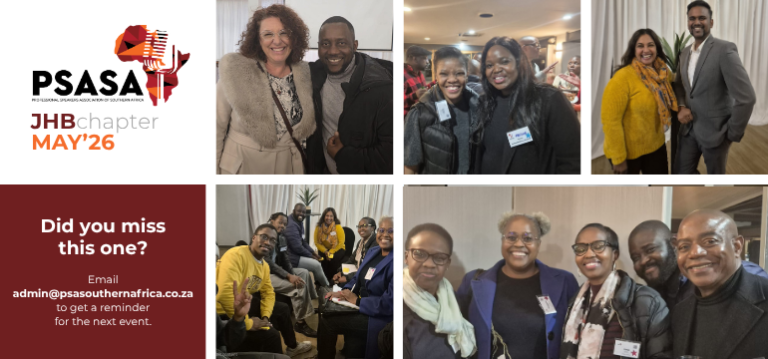
When I heard that Ntando Maseko was presenting on The Profitable Podcaster at the Professional Speakers Association of Southern Africa meeting on Thursday evening, 21 May, my first thought was:
“Ag no man. Not another person trying to convince us all to start podcasts.”
To be honest, I wasn’t particularly keen to go.
But I’m on the committee and didn’t want to get on the wrong side of Kim Vermaak. Nobody does.
And I’m very glad I went.
You see, I’ve been trying to convince myself to get into podcasting for close on twenty years now, and it has always felt like an enormous schlep. Huge effort. Dubious return. Cameras. Editing. Uploading. Thumbnails. Algorithms. The whole thing just looked exhausting.
Ntando spoke directly to a lot of those fears.
Not all of them. I still think parts of it look like a schlep.
But he reframed podcasting in a way that made much more strategic sense to me.
Most people think podcasting is about content.
It isn’t.
It is about positioning.
That was the real insight sitting underneath much of what he shared.
The best podcasters are not simply uploading conversations to the internet. They are building trust, shaping perception, creating familiarity and establishing authority long before a sales conversation ever happens.
And suddenly podcasting made a lot more sense to me.
Because if you are a speaker, consultant, strategist, educator or thought leader, you are not really monetising the podcast itself.
You are monetising the trust the podcast creates.
That distinction changes everything.
Ntando also made another point that landed hard with the room.
Different podcasts serve different strategic purposes.
Some are optimised for business leads.
Some for authority.
Others for visibility and discovery.
Most people try to optimise for all three at the same time and end up creating confused content that does none of them particularly well.
The smarter question is:
“What role does this content play in my commercial ecosystem?”
That is a very different way of thinking about media.
What also struck me was his emphasis on evergreen content.
Reactive content spikes.
Evergreen content compounds.
A good conversation recorded today can still build trust, authority and opportunity five years from now. It becomes intellectual real estate sitting online, continuing to work long after you’ve forgotten you recorded it.
That idea connected with something Daniel Priestley has been saying for years.
I have a slightly unhealthy man-crush on Daniel Priestley because his advice is annoyingly good.
One of his ideas is that creators and speakers should have at least seven hours of content available online so potential clients, audiences and partners can properly understand who they are and how they think.
Every time I heard that, I thought:
“There is absolutely no ways I am creating seven hours of content.”
Then, only a few days after Ntando’s presentation, I was chatting to my friend Charles Weyer about this exact problem and asked him how on earth I was supposed to produce seven hours of content.
His answer was immediate.
“Get on podcasts. Get interviewed. Interview people.”
And suddenly the whole thing clicked.
Between Maseko, Priestley and Weyer, I had what can only be described as a perfect storm of synchronicity.
Because podcasting no longer looks like content production to me.
It looks like infrastructure.
A podcast is not simply a media channel.
It is a trust-building machine.
A positioning asset.
A searchable archive of how you think.
And for speakers, consultants and thought leaders, that may turn out to be far more valuable than the podcast itself.
I suspect many of us are going to come to that conclusion over the next few years.